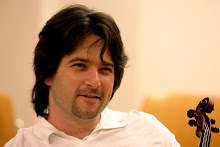
I am writing these words from Krakow airport after an intense but very satisfying week. I am coming back from a festival in Zakopane after being invited by Janush Wawrowski, one of my dearest friends, a student of my father (and I am proud to say I have been on the teacher seat for him as well). He is a fantastic violinist and a complete artist and you should check him out, especially the amazing version of Paganini caprices for violin and cello (arranged and performed by the phenomenal Marcin Zdunik).
This was his (and his talented wife, Bogumita Dziel) first experiment with making a festival, called "music in the mountains" and it featured artists such as the Kronos Quartet, the pianist Ewa Problocka and another dear friend of mine: the violin virtuoso Vadim Gluzman.
The festival was planned to showcase Polish music, which is mostly unknown even in Poland, and it certainly was an education. The Polish people have warm hearts and romantic souls and this is reflected in their music. I recommend wholeheartedly listening to Noskowski piano quartet, especially the divine second movement which is Brahmsimian like in its expanse. Vadim played the wonderful Karlowicz serenade, which is an absolute must for any violinist. Check out the polish romantic composers, ladies and gentlemen, there are real gems out there.
What I loved about this festival was the seriousness of the musicians, some of them in their early twenties. Poland is slowly becoming an exporter of fine musicians and every single one of the people I listened to or played with was accomplished and ready. Rehearsals were serious but also fun; everyone knew their scores and could "hold it together". Most important, there were no "egos" at play, not even when arguing about musical ideas, you said your flash of inspiration and if people did not like it, well, then you just went along with whatever most people feel like doing. The result was mind blowing. The last concert featured Schubert Trout Quintet, Krogulski octet (fun and funny piece) and Brahms sextet no.1 which rocked the house.
We all stayed in good hotels, had fine meals, receptions after every concert some of us perfected our pool playing technique. We played hard, and then we partied pretty well too, and believe me, after 8 hours of intense rehearsal lowering one self into a warm, bubbly Jacuzzi is not a luxury, it is a necessity.
So I got to play wonderful music, with amazing musicians, made some friends, partied, oh, and got paid for it too... Every once in a while comes and experience which makes you happy being a musician and this was definitely one of them.
Tuesday, 29 September 2009


Monday, 26 January 2009
The Bubble
This was a phone conversation around eight months ago:
Vesa: eyal, do you happen to play the viola?
Me: What are you talking about, I thought we were friends, how dare you imply…
Vesa: because if you do, we can play the concertante together.
Me: Of Course I can play the viola…
So I learned to play the Viola and flew to New Zealand.
Every time I go to New Zealand I come back rejuvenated. The country is beautiful, the people are just the nicest in the world but the best part of the trip is meeting my friend, Vesa-Matti Leppanen, who is the concert master of the NZ symphony orchestra. Every time we meet I learn something new (and not just how to play a new instrument).
This time I learned about the Bubble (or "the circle"); a technique Vesa uses on stage when playing solo, especially with orchestra. I have tried it myself and I wished I knew this years before, it is very effective.
The idea is that going on stage to play a concerto, with an orchestra behind you and hundreds of people in front of you can be a tad overwhelming…
In the rehearsal you find the space around you that you define as "mine" and create in imaginary circle. Inside the circle you are safe; nothing can come in, only come out. You play within the circle like playing inside your room, with your eyes fixed to the edge of the circle to stop them moving around the place (which can lead to all sorts of trouble).
There are three of those circles which increase in size. The smallest one is saved for those difficult passages and moments, the largest one is for the moments you want to include the audience and you can switch between them at will.
Thank you Vesa…
Vesa: eyal, do you happen to play the viola?
Me: What are you talking about, I thought we were friends, how dare you imply…
Vesa: because if you do, we can play the concertante together.
Me: Of Course I can play the viola…
So I learned to play the Viola and flew to New Zealand.
Every time I go to New Zealand I come back rejuvenated. The country is beautiful, the people are just the nicest in the world but the best part of the trip is meeting my friend, Vesa-Matti Leppanen, who is the concert master of the NZ symphony orchestra. Every time we meet I learn something new (and not just how to play a new instrument).
This time I learned about the Bubble (or "the circle"); a technique Vesa uses on stage when playing solo, especially with orchestra. I have tried it myself and I wished I knew this years before, it is very effective.
The idea is that going on stage to play a concerto, with an orchestra behind you and hundreds of people in front of you can be a tad overwhelming…
In the rehearsal you find the space around you that you define as "mine" and create in imaginary circle. Inside the circle you are safe; nothing can come in, only come out. You play within the circle like playing inside your room, with your eyes fixed to the edge of the circle to stop them moving around the place (which can lead to all sorts of trouble).
There are three of those circles which increase in size. The smallest one is saved for those difficult passages and moments, the largest one is for the moments you want to include the audience and you can switch between them at will.
Thank you Vesa…
Thursday, 25 September 2008
12 Frequent Mistakes During Practice,
In practicing basic technique – to concentrate purely on one aspect of technical problem without paying any attention to anything else is a grave mistake. While working on intonation, for example, you should always keep your eyes on the right arm as well and focus your tone.
In practicing pieces – practicing shifts without considering the speed and direction of the shift and whether you will use vibrato or not.
In practicing pieces – learning initially “only the notes” without musical agenda is one of the most common mistakes by students. Since the music agenda dictates speed, loudness, articulation, phrasing, timing, fingerings, tone production, use of vibrato and bowings, to say the least, not considering musicality from the very first stages makes the entire process of practicing a waste of time.
In practicing pieces – not bringing immediately (on first practice session) every segment that is played to performance level. Playing a piece or a segment of a piece, thinking “it will be good one day, maybe tomorrow, or the day after…” is never going to help you get it right. From the very beginning of learning you should strive to bring yourself to performance level (including learning by heart), and it does not matter whether you are practicing two lines, two measures or a whole fugue.
Not asking “why did it go right?” – We make a point when thing go wrong but seldom stop to think when we make it right. This is a crucial point of practicing since after spending time and effort and having overcome the difficulty, we should ask ourselves the following questions:
What have we done to make this work,
And
Can we guarantee that it will work in performance the first time we play it (hint: if the answer is “no”, do it again).
Not practicing with “performance mentality” – there is a vast difference, both mentally and physically, between playing through a piece after an hour or two of practice while being alone in a room, and stepping on a stage and doing it for the first time in front of a panel of jury. In the first case you feel warmed up and safe, having played the piece several times and it being fresh in your mind and knowing that you can stop at any time. In the second case you have to perform your best under great pressure and play through the piece without stopping to correct yourself or being given a second chance.
Many times I heard students complain “but it worked in the practice room” only to find out that they never tried to play the piece through before the lesson or did not properly learned it by heart. When you get to performance level make sure you put yourself under the same conditions as a real performance. This includes: recording yourself, playing the piece through with only a short warm up, awareness of where you will be playing (big stage, sitting down), the amount of movement space (never walk around) and performing to friends.
In practicing technique – not making the connection between the technical element you are improving and the pieces you are playing. Did you just spent precious time working on your spiccatto? Why not move immediately to the moment in the pieces you need to use it. Worked two hours on correcting your bow arm? Don’t throw it to the wind the second you begin playing the concerto.
Losing the ideal - always be connected to the mental “image”, or “sound”, of what you are trying to achieve. Never let your hands dictate the music and keep measuring what you actually play to what you really want to play.
“I already know that part” – no you don’t… and its younger sibling: “that’s easy” (no it’s not).
Not knowing the piano part/orchestra part of the sonata/concerto – of all the silly mistakes…
Following blindly the fingerings and bowings that are on the page – not every fingering is good for all players and not all bowings have the same musical agenda you might have. Mix it up, try different things, be imaginative, daring and curious about the sound variations you can produce. Come on… live a little.
Not following blindly the fingerings I gave you in our last lesson – yes, I know… (But it makes sense to me).
In practicing pieces – practicing shifts without considering the speed and direction of the shift and whether you will use vibrato or not.
In practicing pieces – learning initially “only the notes” without musical agenda is one of the most common mistakes by students. Since the music agenda dictates speed, loudness, articulation, phrasing, timing, fingerings, tone production, use of vibrato and bowings, to say the least, not considering musicality from the very first stages makes the entire process of practicing a waste of time.
In practicing pieces – not bringing immediately (on first practice session) every segment that is played to performance level. Playing a piece or a segment of a piece, thinking “it will be good one day, maybe tomorrow, or the day after…” is never going to help you get it right. From the very beginning of learning you should strive to bring yourself to performance level (including learning by heart), and it does not matter whether you are practicing two lines, two measures or a whole fugue.
Not asking “why did it go right?” – We make a point when thing go wrong but seldom stop to think when we make it right. This is a crucial point of practicing since after spending time and effort and having overcome the difficulty, we should ask ourselves the following questions:
What have we done to make this work,
And
Can we guarantee that it will work in performance the first time we play it (hint: if the answer is “no”, do it again).
Not practicing with “performance mentality” – there is a vast difference, both mentally and physically, between playing through a piece after an hour or two of practice while being alone in a room, and stepping on a stage and doing it for the first time in front of a panel of jury. In the first case you feel warmed up and safe, having played the piece several times and it being fresh in your mind and knowing that you can stop at any time. In the second case you have to perform your best under great pressure and play through the piece without stopping to correct yourself or being given a second chance.
Many times I heard students complain “but it worked in the practice room” only to find out that they never tried to play the piece through before the lesson or did not properly learned it by heart. When you get to performance level make sure you put yourself under the same conditions as a real performance. This includes: recording yourself, playing the piece through with only a short warm up, awareness of where you will be playing (big stage, sitting down), the amount of movement space (never walk around) and performing to friends.
In practicing technique – not making the connection between the technical element you are improving and the pieces you are playing. Did you just spent precious time working on your spiccatto? Why not move immediately to the moment in the pieces you need to use it. Worked two hours on correcting your bow arm? Don’t throw it to the wind the second you begin playing the concerto.
Losing the ideal - always be connected to the mental “image”, or “sound”, of what you are trying to achieve. Never let your hands dictate the music and keep measuring what you actually play to what you really want to play.
“I already know that part” – no you don’t… and its younger sibling: “that’s easy” (no it’s not).
Not knowing the piano part/orchestra part of the sonata/concerto – of all the silly mistakes…
Following blindly the fingerings and bowings that are on the page – not every fingering is good for all players and not all bowings have the same musical agenda you might have. Mix it up, try different things, be imaginative, daring and curious about the sound variations you can produce. Come on… live a little.
Not following blindly the fingerings I gave you in our last lesson – yes, I know… (But it makes sense to me).
About computer games and playing Bach Chaconne
When you fire up a computer game you enter a totally imaginary world. It can be a space odyssey or an empire building game or anything else, and you know it is not “real”, it does not exist. Yet, the world which is presented to you, as fantastic as it may be, lies within a set of logical rules. The game, and the “world”, has to make sense to us and we must understand the settings in which we operate in; how many “lives” we have, how we can make “money” or become more powerful etc.
The same rules apply to novels and books or movies. You will not accept the settings of a science fiction novel if they appeared in an autobiography of a real person and an historical drama set in ancient
The same set of rules of reality making applies to playing Bach, Mozart, or any other piece. in this case, you, the performer, are responsible to show the listeners the “rules of the musical piece”, the logic in which the piece is played.
The classical world is full of “do”s and “do not”s and each era, Baroque to twelve-tones system, has its own set of rules to be followed (or ignored, according to your personal taste). The important bit is to stay within the rules you selected to follow so as to make sense in the context of the piece. Whether it is the direction of sequences in Bach and where you break them, the aggressiveness of articulation you use in Mozart, the thickness of your tone in Tchaikovsky or the lushness of your sound in Frank, these are the tools with which you present to the audience their reality and like a good novel or an exciting game, these rules should be apparent and consistent throughout the piece.
This is why the beginning of a piece is so crucial musically: your tone, articulation, phrasing, and even attitude should immediately set the boundaries in which you operate an everything you will change as you progress is relative to what your audience experienced before.
Tuesday, 24 June 2008
About the Fingers
I will generalize and say that most students tend to leave their fingers too much on the strings. This tendency has several reasons: most of us were taught this way as kids and keeping the fingers down to secure intonation, the will to keep the hand position and the wish not to move fingers which are “already in tune”. For example: you can see someone playing first finger, then fourth finger and back to the first without lifting the first. Another example, playing a D with the second finger (on G) then needing to play a fifth(A); instead of lifting the finger and repositioning it, the tendency is to twist the finger and squeeze between the strings.
There is nothing too wrong about those examples except that usually the fourth finger will probably not vibrate and the chances for a good, clean fifth are not very good.
When we press a note and keep on pressing we not only have certain pressure in the finger and hand, we also accumulate tension as well, which means the longer we hold the finger the stronger the tension. By lifting the finger we alleviate the pressure and the cancel tension.
When playing in a slow, singing style it is important to keep the hand as free from tension as possible in order to vibrate freely. This aspect, which falls under “musicality” and “sound” elements (see previous blogs for more about the ‘elements’), outweighs the extra “security” of intonation. Yes, you may have to take more time in practicing intonation and perhaps a few risks but the end result will be better quality music, which is what counts.
Lifting the fingers from the string is incredibly important in fast passages as well.
Since there are so many possibilities for error, I suggest taking some time and play parts of your repertoire in a “finger after finger” mode, in which only one finger touches the string at all times (except double stops and chords, of course). The fingers do not need to “fly up in the air” but be released and off the string unless they are pressing the note that is being played. This is a good way to find where you actually need to keep the fingers down and when the possibility exists to free the hand.
Tuesday, 27 May 2008
Holding the violin
Perhaps the biggest problem violinists have is the way the instrument is held. The unnatural way of holding the violin, combined with the difference in physical build of each individual student make the whole issue quite complicated and the solution personal.
There are two issues that need to be addressed: the angle of the violin, which is held by the body and the proportion between supporting the violin with the neck and the hand.
Ideally, the violin should be resting on the collar bone although for many players with a long neck it is simply not an option. What I would make sure, though, is that the violin should be stable. When you lift the head from the chin rest the violin should not slip downwards. This is very important because if the violin is held in a steep angle, the violinist would always clasp the instrument between shoulder and neck without any relief. This is one of the biggest causes of injuries, since the damage to the muscles and even bones is accomulated over time.
Another problem caused by a bad violin hold is that the instrument “falls” into the palm of the left hand, meanning that the support for the violin neck comes from the right side (from the violinist point of view). That makes the violinist clasp the neck and makes vibrato, a movement which demands freedom, a difficult task.
How we support the violin is crucially important. Ergardless of the silly notion that the violin should be only held by our own neck, if you clasp the violin’s neck from the sides, leaving the underneath free, the violin will always drop when you release the grasp. The outcome of such hold is that the violinist never releases the grasp from both sides of the violin’s neck, restrichting vibrato and shifting.
The 4th position is perhaps the easiest, physically the most comfortable position for holding the violin and why? Because the thumb gives the best support from underneath the neck, so the hand holds the violin from the down and up sides instead of the right and left side of the neck.
Ideally the violin’s neck should be supported from bellow and it is up to you to try to find the best hand position to follow such ideal. Some people prefer using the lower part of the thumb, which curls underneath the neck, others prefer to use the upper part of the thumb as support.
Sunday, 4 May 2008
The Four Elements
There are four elements which make up a performance of any piece. I call these elements “building blocks” because they are roughly depending on each other from the most basic form of playing to the performance stage. When practising any part of any piece you should be aware of all four building blocks, perhaps practising each of them separately at first.
The first building block is “Technique”: This encompass intonation, rhythm and “special effects” (such as up bow staccato, for example). Basically all the “nuts and bolts” which make the piece. Mastering this element require slow work for intonation (including no vibrato), careful shifts in “slow to speed” mode, group rhythms and the use of metronome. When working on intonation assume you are playing 100% out of tune and prove to yourself that each note is in tune, and be convinced it can be produced in the future.
The second building block is “sound”: there is no use in playing in tune if you are playing ugly. Working on sound should be roughly divided to vibrato and bow practice. When practising sound you should mainly listen to yourself for any unintentional sound effects you make when beginning a note and in between the notes. I divide sound to three parts “head of the note, body of the note” and “tail of the note”. whenever you make unintentional sounds it will be in one of those three parts. A scratch in the beginning of the note (head) could mean you approached it from the air without control, or use too much arm weight too soon. A swelling mid note (body), or extra string sounds could mean you are in the wrong position with your elbow, use too much bow speed, drop arm weight on the bow unevenly or pressing the string too hard on high positions with your fingers.
You should also work on seamlessly moving from one bow technique to another (for example a detache which turns into spicatto). In short: work to achieve pure sound with the bow and good, free, expressive vibrato.
Once you mastered the first and second building blocks you are “on par” with the piece, at the required to actually do something with it, infuse it with your own ideas.
The third building block is “musicianship”: This element is hard to define on it’s own, because it affects the previous elements. If you practiced the first two building blocks without acknowledgment of the music idea, you probably wasted your time. Style, sound production, amount of vibrato, expressive pauses, loudness and many other musical elements directly effect the first two building blocks and if you practised them without being aware of the musical ideas, you would probably sound like an automated machine.
Yet although musicianship is connected to all the other building blocks I still think it should also stand on it’s own, simply because after conquering the first two elements you should take time and be free to explore your musical ideas and make sure they were not lost in during the long process of conquering the piece technically.
The last element, and the one your paying public will be the most aware of, is “character”: I do not mean “character of the piece” (which belongs to musicianship) but your own character. Many times we lose ourselves when we study a piece for a long time, trying to master the perfect technique and mix it with the “right” musical ideas. Yet no matter how many rules of playing Bach or Mozart are imposed on your playing, the piece should still be distinctly “yours”. Your personality; how you act and react on stage, what ideas and ideals you bring with yourself to the performance and the belief in what you produce, affect the reaction of the public to the performance more than any other element. As part of the practice you should reflect upon what the piece make you feel and what you want to bring to the audience.
We hear so many soloists playing the same pieces, and they all play them in different ways. Regardless of our own, expert opinion about individual performances or style, they all have reached success because they have mastered the four elements.
The first building block is “Technique”: This encompass intonation, rhythm and “special effects” (such as up bow staccato, for example). Basically all the “nuts and bolts” which make the piece. Mastering this element require slow work for intonation (including no vibrato), careful shifts in “slow to speed” mode, group rhythms and the use of metronome. When working on intonation assume you are playing 100% out of tune and prove to yourself that each note is in tune, and be convinced it can be produced in the future.
The second building block is “sound”: there is no use in playing in tune if you are playing ugly. Working on sound should be roughly divided to vibrato and bow practice. When practising sound you should mainly listen to yourself for any unintentional sound effects you make when beginning a note and in between the notes. I divide sound to three parts “head of the note, body of the note” and “tail of the note”. whenever you make unintentional sounds it will be in one of those three parts. A scratch in the beginning of the note (head) could mean you approached it from the air without control, or use too much arm weight too soon. A swelling mid note (body), or extra string sounds could mean you are in the wrong position with your elbow, use too much bow speed, drop arm weight on the bow unevenly or pressing the string too hard on high positions with your fingers.
You should also work on seamlessly moving from one bow technique to another (for example a detache which turns into spicatto). In short: work to achieve pure sound with the bow and good, free, expressive vibrato.
Once you mastered the first and second building blocks you are “on par” with the piece, at the required to actually do something with it, infuse it with your own ideas.
The third building block is “musicianship”: This element is hard to define on it’s own, because it affects the previous elements. If you practiced the first two building blocks without acknowledgment of the music idea, you probably wasted your time. Style, sound production, amount of vibrato, expressive pauses, loudness and many other musical elements directly effect the first two building blocks and if you practised them without being aware of the musical ideas, you would probably sound like an automated machine.
Yet although musicianship is connected to all the other building blocks I still think it should also stand on it’s own, simply because after conquering the first two elements you should take time and be free to explore your musical ideas and make sure they were not lost in during the long process of conquering the piece technically.
The last element, and the one your paying public will be the most aware of, is “character”: I do not mean “character of the piece” (which belongs to musicianship) but your own character. Many times we lose ourselves when we study a piece for a long time, trying to master the perfect technique and mix it with the “right” musical ideas. Yet no matter how many rules of playing Bach or Mozart are imposed on your playing, the piece should still be distinctly “yours”. Your personality; how you act and react on stage, what ideas and ideals you bring with yourself to the performance and the belief in what you produce, affect the reaction of the public to the performance more than any other element. As part of the practice you should reflect upon what the piece make you feel and what you want to bring to the audience.
We hear so many soloists playing the same pieces, and they all play them in different ways. Regardless of our own, expert opinion about individual performances or style, they all have reached success because they have mastered the four elements.
Subscribe to:
Posts (Atom)